

Open source computational fluid dynamics (CFD) software
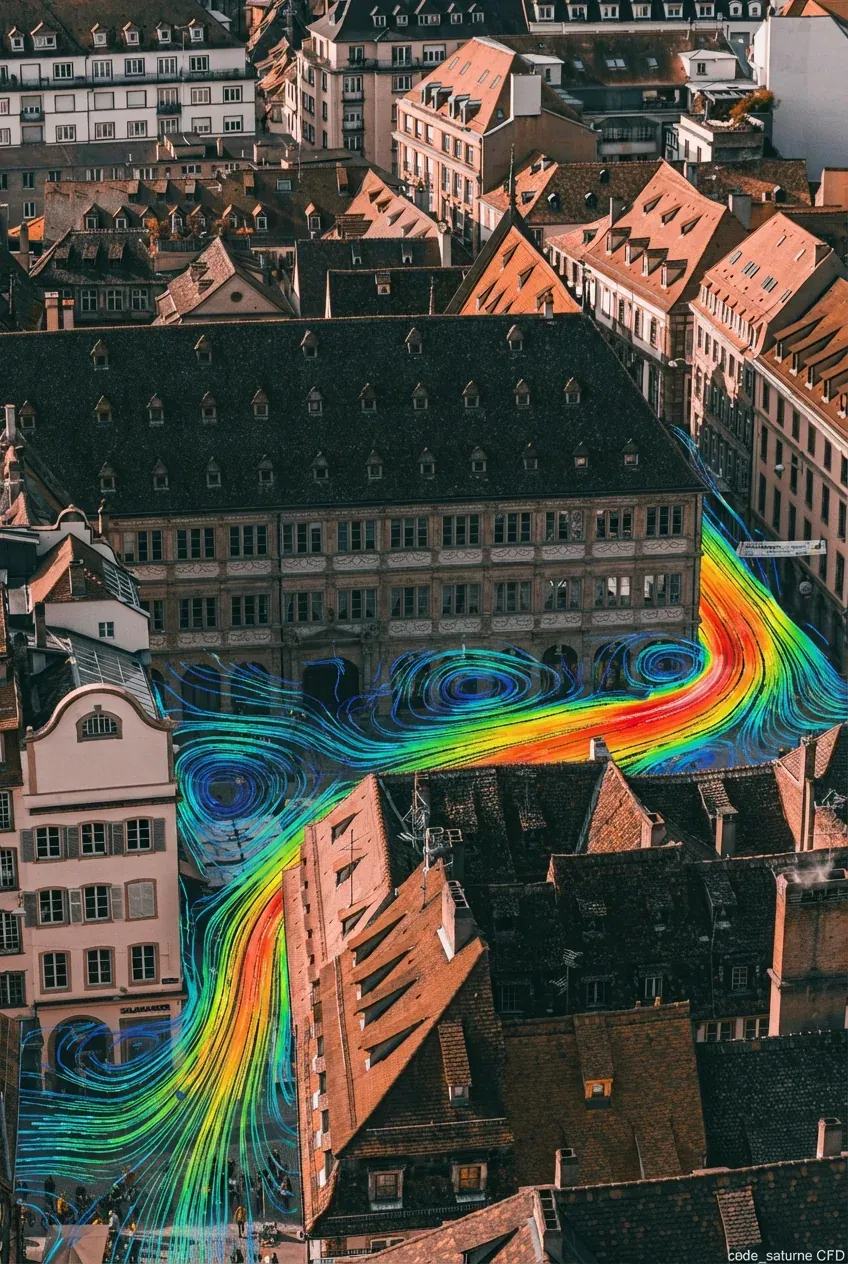
code_saturne is much more than a CFD code: it is an open industrial platform, proven over 25+ years and driven by an active community
Origin & Legitimacy
- Developed by EDF since 1997 for industrial CFD challenges
- Distributed as open source under the GNU GPL licence since 2007
- Decades of development and a vast base of test cases
Technical power
- Solves the Navier-Stokes equations with the finite volume method
- Incompressible or compressible, steady or unsteady flows
- Advanced models: turbulence (RANS, LES), heat transfer, multiphase, combustion, radiation, species transport
Quality & Reliability (V&V)
- Rigorous Verification and Validation process
- Robust software architecture, representative of real industrial systems
- An active community of users and developers that strengthens code quality
HPC performance
- MPI parallelisation, deployment on clusters and cloud environments
- Handles large domains with complex geometries
- Massive design, optimisation or safety simulations with no licence overhead
Open Source & Transparency
- Free: no licence cost
- Full transparency of physical and numerical models, easing audit and adaptation
- Ideal for regulatory justification studies
Ready to master code_saturne?
Useful links


Our latest news
 In-depth
DARPA SUBOFF: using code_saturne for naval hydrodynamics
code_saturne on the DARPA SUBOFF AFF-8 on a lightweight pre-design mesh
September 7, 2026 In-depth
Thermal stratification in an underfloor-ventilated room: comparing code_saturne against the Zhang and Chen experiment
An underfloor air distribution (UFAD) validation study: code_saturne v9.1 and OpenFOAM v2406 simulate Zhang & Chen's (2006) room experiment on the same mesh.
July 24, 2026 In-depth
code_saturne for pedestrian comfort: comparison with OpenFOAM on the AIJ Niigata benchmark
Urban CFD benchmark in Niigata: code_saturne v9.1 compared with OpenFOAM and the AIJ wind-tunnel experiment for pedestrian comfort.
July 1, 2026 In-depth
Simulating urban heat islands with code_saturne: a path toward climate-resilient cities
An in depth dive into a study to accurately study the heat processes in a city with the atmospheric module of code_saturne. A guide for urban design.
June 25, 2026 In-depth
Marine application: how does code_saturne perform against OpenFOAM? (PPTC VP1304 case)
CFD simulation of VP1304 propeller: Code_Saturne vs OpenFOAM (RANS k-ω SST). SVA Potsdam benchmark comparison
June 15, 2026