
openTELEMAC

openTELEMAC: open source software for environmental hydraulic calculations
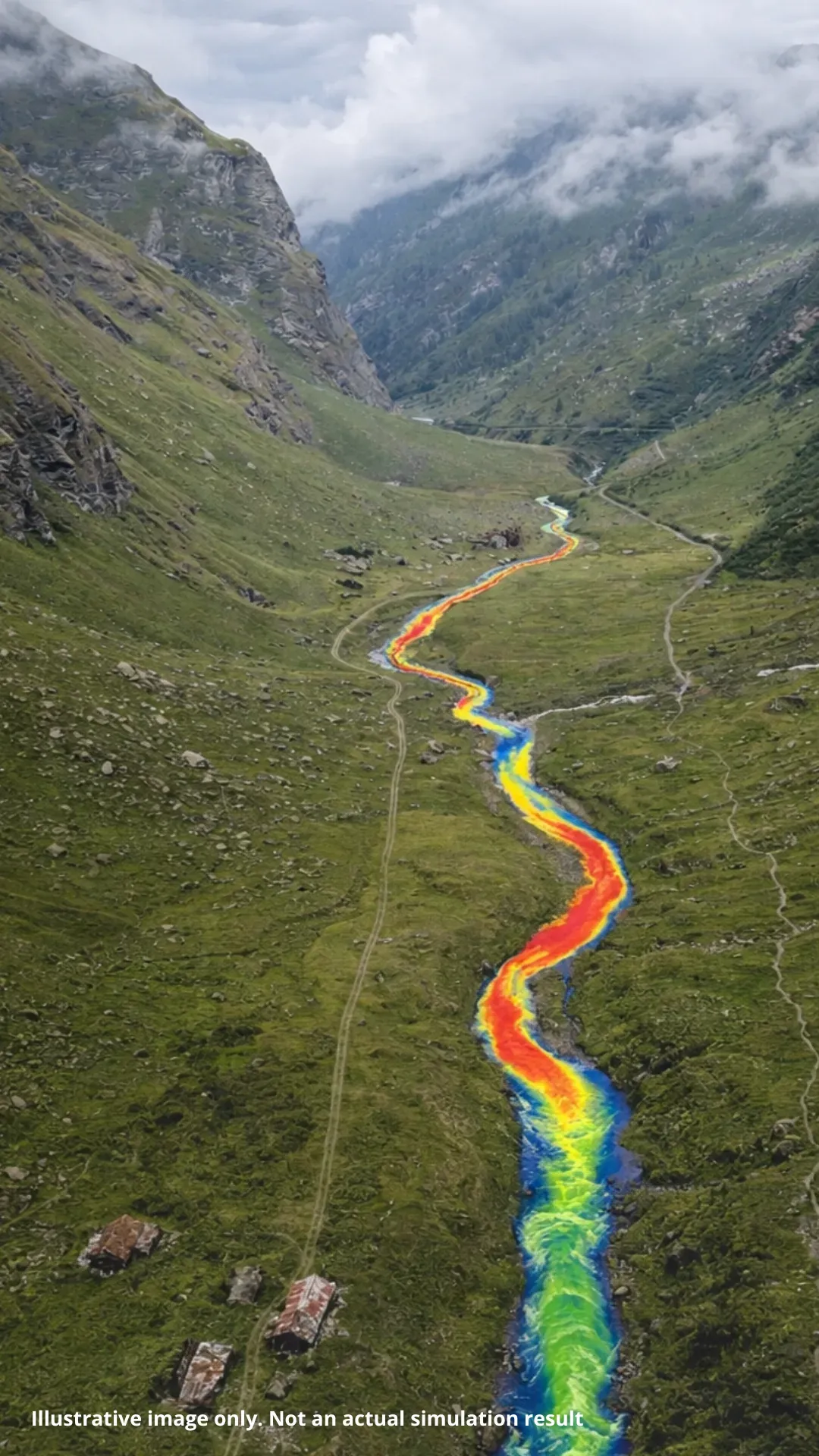
An AI-generated illustration showing a large river with an heatmap.

openTELEMAC

openTELEMAC: open source software for environmental hydraulic calculations

What is openTELEMAC?

openTELEMAC is an open-source simulation software developed by EDF to address environmental hydraulics challenges. It enables both quantification of phenomena and risks generated by aquatic environments (floods, waves, storm surge...) as well as impacts generated by human activities on the environment (thermal and chemical releases, obstacles to hydrological and sedimentary continuity).
Developed over more than 35 years and after several years of commercial distribution, openTELEMAC has been published as open source under the GNU GPL license since 2010 by the TELEMAC-MASCARET consortium. Today, openTELEMAC is at the center of a vast network of academics and industrialists involved in environmental hydraulics issues.
openTELEMAC is a finite element solver based on the Reynolds-averaged Navier-Stokes (RANS) equation. It also offers finite volume solvers, and uses several methods combining both numerical schemes. Optimized for domains on the order of kilometers and time scales that can span years, this software is much better suited than a CFD code for describing any free-surface fluid. It is also compatible with multi-thread and multi-core parallelization and adapted for industrial HPC use.
openTELEMAC is structured around three main modules describing hydrodynamics that can be used depending on whether the flow can be assimilated to a 1D, 2D, or whether 3D effects cannot be neglected. We then speak of MASCARET (1D), TELEMAC-2D, or TELEMAC-3D.
openTELEMAC also has specialized modules allowing the inclusion of a wide variety of physical phenomena coupling with hydrodynamic modules.
  • GAIA allows studying relief evolution by considering erosion and sedimentation phenomena. It models the interactions between suspended and bed sediments to predict surface evolution on which flows occur.
  • KHIONE allows accounting for all phenomena related to freezing and water melting, frasil formation, and heat exchange between phases.
  • TOMAWAC and ARTEMIS are modules with different approaches that allow studying waves respectively. ARTEMIS uses the hydrodynamic calculation result to predict wave propagation, diffraction, or reflection in coastal zones and ports (linear wave, steady-state regime). TOMAWAC models wave generation (and is directly coupled to hydrodynamics) in open and coastal seas.
  • WAQTEL specializes in studying water quality. With a modular architecture decomposable into sub-modules, it allows studying in particular oxygenation (with a naive model or more complex models that can include photosynthesis), algae, temperature, micropollutants and their potential sedimentation in the bed and radioactive pollutants degradation (or bacteria). It can be customized to consider more complex chemical reactions.
Finally, openTELEMAC is also provided with 200 validation cases representative of the different physics it models.

openTELEMAC applications

Due to its wide variety of models and studied physics, openTELEMAC is used to model varied hydrodynamic and environmental phenomena. We cite here some standard uses.
A 3D rendering of some kind of river.

River floods, marine submersions, dam failures...

openTELEMAC is used by various organizations responsible for land planning to study flood risk zones, size the protective means or organizations to implement for water management.

A sort of heatmap of the ocean near the coasts.

Functioning of aquatic ecosystems (fluvial, lacustrine, maritime and estuarine)

The code is widely used to model a wide variety of phenomena:

  • Studies of ocean currents and waves (tidal prediction, sizing of offshore structures and coastal or port protections...)
  • Erosion or sedimentation of natural environments (siltation of estuaries, mangroves, water intakes etc.)
  • Evolution of tracer releases, chemical or thermal in an aquatic ecosystem
  • Prediction of water quality evolution (eutrophication, thermal or salt stratification...) and risk areas (heavy metals, e-coli, bacteria).
A bird-eye view of a river with some heatmap.

Research & education

The academic community is very active around openTELEMAC. The consortium itself includes academics and theses are regularly defended around openTELEMAC, increasingly incorporating specialized models and case studies.

openTELEMAC is also a reference in hydraulics training offered by several engineering schools and universities, in France and internationally. Its free use and the availability of its complete documentation allow students to train on a professional tool without financial barriers, while having access to theoretical foundations through user, theory, and validation documentation.

openTELEMAC events

Each year the community and the Consortium meet to exchange at the TELEMAC-Users-Conference (TUC). This conference is an opportunity for Consortium developers to present recent developments and discuss perspectives for evolution and improvement of the code. It also allows users (both academics and industrialists) to present studies and projects that have often led to publications.
Articles and reports from previous TUC years can be found at: https://henry.baw.de/browse/subject?scope=e255cbb3...
A dedicated forum is also very active and allows users to exchange and help each other with their studies. This also allows potential issues to be reported which are directly transmitted to EDF R&D and Consortium developers.

Resources

Useful links