Simvia at the 5th Automotive CFD Prediction Workshop (AutoCFD5)
An open-source solver on the reference cases of automotive aerodynamics: see how code_saturne performs, from steady RANS to hybrid RANS-LES.
Overview
AutoCFD brings the automotive CFD community together around shared test cases and a comparison of predictions. Geometry, boundary conditions and computational grids are prescribed, so that the predictive capability of CFD codes on road-car geometries can be assessed objectively and turned into practical guidance on turbulence modelling, meshing and numerical schemes.
The 5th edition takes place on October 8 and 9, 2026 at DAMA Technopole in Bologna, Italy. On October 8 at 2:25 PM, our team will present how the open-source code code_saturne performs on the workshop cases, from steady RANS to hybrid RANS-LES. If you work on aerodynamics, it's a direct way to see how an open-source solver holds up on these cases.
Why attend
- A common test bench: all participants work on the same geometries, conditions and grids, making comparisons between codes and methods directly meaningful.
- Practical guidance on best practice: turbulence modelling, meshing, numerical schemes, scale-resolving simulations, HPC and AI/ML.
- An established community: after Oxford (2019), Berlin (2021), Barcelona (2022) and Belfast (2024), the workshop brings together researchers and engineers from industry and academia, including car manufacturers.
- Evaluate an open-source alternative: our talk shows what code_saturne can achieve on these cases alongside the other solvers represented.
What you will learn
October 8, 2:25 PM – Assessment of the open-source CFD code code_saturne on the AutoCFD workshop cases: from steady RANS to hybrid RANS-LES "Scale Resolving Simulation" session
- The results obtained with code_saturne on the workshop's reference configurations
- The progression of approaches, from steady RANS to hybrid RANS-LES simulations
- How an open-source solver compares with the other codes assessed

Florian Hermet
Senior CFD engineer
Florian contributes to the development of Simvia's numerical simulation solutions, focusing on fluid dynamics and the modeling of complex flows. Holding a Ph.D. in fluid mechanics, he leverages over eight years of experience in numerical simulation and aerodynamic design to strengthen Simvia's R&D capabilities.
Learn morePractical details
- Date
- From October 8, 2026 to October 9, 2026
- Location
- DAMA Technopole, Bologna (Italy)
- Workshop dates: Thursday, October 8 and Friday, October 9, 2026
- Simvia talk: Thursday, October 8, 2:25 – 2:40 PM (Central European Summer Time, CEST)
- Venue: DAMA Technopole, Bologna (Italy)
- Organisers: Upstream CFD, with support from CINECA
- Full programme: AutoCFD5 agenda
You might also like…
![[Replay] csauto to automate CFD campaigns with code_saturne](https://i.ytimg.com/vi/n0EgpuYEt8Y/hqdefault.jpg) Video
VideoSeptember 29, 2026
[Replay] csauto to automate CFD campaigns with code_saturne
The second webinar in the [Simvia Insider] series, dedicated to improving the user experience of the EDF open-source simulation ecosystem. Here Mariam explains how you can now install and use code_saturne easily, without having to build anything from source, with the Docker image provided by Simvia. In addition, Florian showcases our new tool csauto to automate CFD campaigns in order to run and compare many parametric studies. csauto comes with a web interface that lets you track the state of each run in real time.
 Video
VideoSeptember 22, 2026
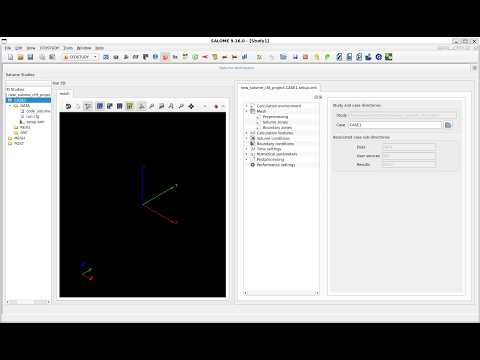
Salome_CFD using the docker version of simvia
This video presents how you can pull and use simvia brand new docker image of salome_CFD: the salome_platform with code_saturne and its graphical interface included. The video assumes the user is either on Linux or has a working virtual machine with WSL, and has docker already installed and working. We will walk you through the download and aliases to add in your bashrc or zshrc in order to run salome_cfd.
 In-depth
September 21, 2026
Scaling open-source industrial solvers on Cloud HPC: Performance benchmarks and configuration guidelines for code_saturne and code_aster on Oracle Cloud Infrastructure
Scaling open-source industrial solvers on Cloud HPC: Performance benchmarks and configuration guidelines